
How smart forecasts keep Woodside rigs safe, productive
Accurate weather forecasts are critical when it comes to divining what Mother Nature has in store for our operations, particularly out at sea.
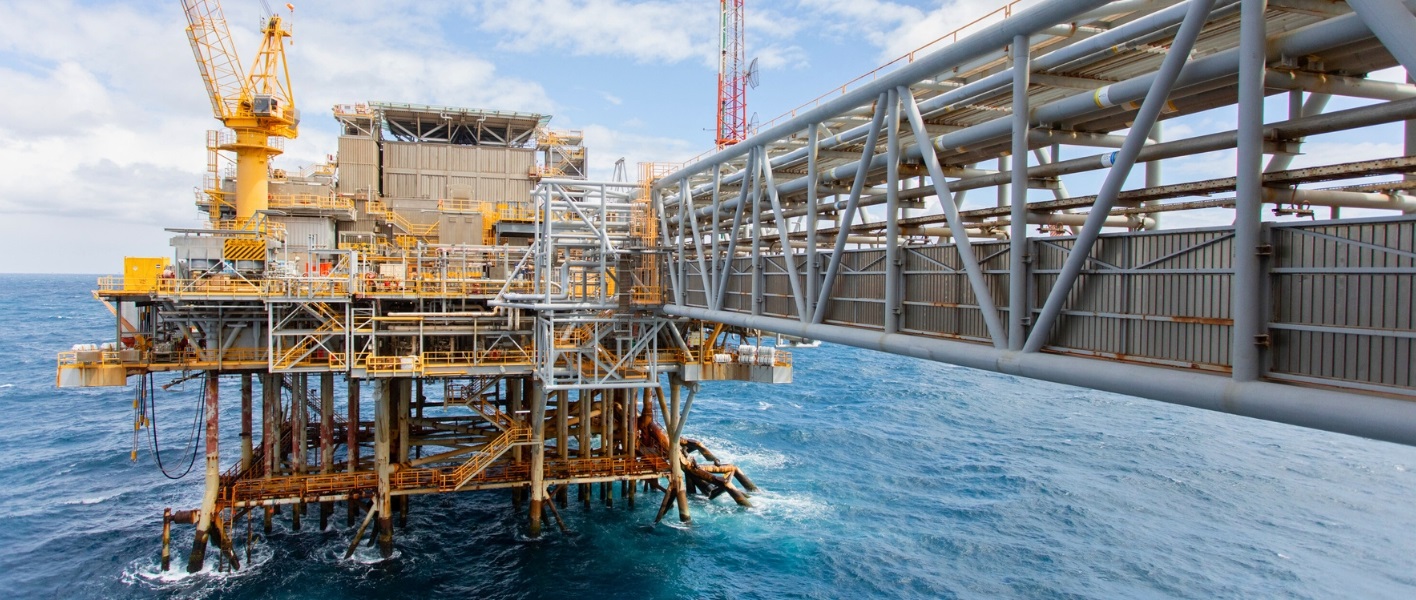
Woodside’s offshore rigs and platforms can move significantly in strong swells, making accurate forecasts of their motions essential – like weather forecasts, but for response to waves – both for safety and reducing weather-related downtime.
To satisfy this need, Woodside’s advanced Vessel Operability Planning Service (VOPS) has been put to great use, supporting five rigs to conduct more than 20 exploration and decommissioning campaigns over the past decade.
The Woodsider driving VOPS is Senior Metocean Engineer Ian Milne.
Ian was based at the University of Western Australia (UWA)’s School of Earth and Oceans, where his work focused on offshore engineering and hydrodynamics.
Since joining Woodside in 2021, he has split his time between Woodside and UWA where he’s Senior Research Fellow within the ARC Transforming energy Infrastructure through Digital Engineering (TIDE) hub, supported by Woodside’s FutureLab.
Leveraging our academic partnership with UWA, Woodside has delivered an advanced, scalable, cloud-based solution tailored to meet our drilling and decommissioning requirements.
“This provides bespoke predictions of rig movement using historical data and forecasts up to 10 days ahead,” Ian notes.
Ian delivers two examples of what this has enabled.
Firstly, earlier and more precise assessments of weather effects on operations minimise downtime for operational planning.
“The Minerva plug and abandonment campaign in the Bass Strait, for example, was able to progress blowout preventer preparations during mooring operations, knowing that the heave-to would be within acceptable limits,” he points out.
VOPS also let us work through heavier weather on the Scarborough Energy Project than we would have otherwise, comfortable in the knowledge that we're not putting our well control equipment at risk."
Secondly, it gives teams better decision support, with faster prediction of hazardous vessel motions which can affect sensitive equipment.
“This allows timely suspension and quicker resumption of operations, reducing non-productive time at sea,” Ian remarks.
VOPS is particularly innovative in that predictions incorporate the full directional wave spectra and vessel response characteristics.
Moreover, measured rig motion data can be used to provide bias-corrected, probabilistic predictions. “This addresses key limitations of traditional methods,” he notes. Having issued to date more than 3000 individual motion forecasts and drawing on more than 50,000 hours of field measurements, the software has been extensively validated.
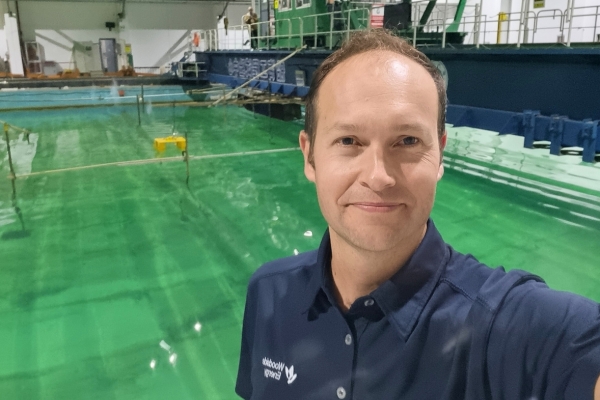
Ian Milne in Shanghai at the wave basin facility, overseeing testing to enhance rig-motion forecasting.
It’s also received comprehensive peer review at various forums.
Unlocking access to real-time rig data – a joint effort by Woodside and Transocean teams across Australia and the USA – has greatly improved service delivery and enabled future developments including the prediction of rig offset (horizontal motions).
“This is particularly important for decommissioning in shallow waters with weak conductors, potentially reducing dependence on tethering and complex mooring systems,” Ian says.
There’s more to come.
Woodside is set to kick off a project to demonstrate the capabilities of AI to predict rig offset.
Another exciting advancement is wave basin-testing of semisubmersibles in a world-class facility, which Ian is leading through UWA.
“This will further enhance the operational guidance in long-period swell available from VOPS, again for the benefit of the business,” Ian concludes.