.tmb-v2-card.jpeg?sfvrsn=63cd1e14_1)
Ningaloo Outlook – Turtle Education Program, CSIRO. Credit: Violeta J. Brosig from Blue Media Exmouth.
Case study



Strong partnerships, sound research and transparency are the key elements of Woodside's approach to the environment.
We understand our interface with high biodiversity values such as natural sites on the UNESCO World Heritage List, Designated Protected Areas and Key Biodiversity Areas and apply our Biodiversity standards together with the mitigation hierarchy to identify appropriate management of impacts and risks to terrestrial and marine biodiversity in regions and areas in which we undertake activities.
None of our oil and gas production assets and new energy projects offshore or onshore overlap with the boundaries of natural sites on the UNESCO World Heritage List.1
No project or activity is undertaken within IUCN category Protected Areas unless compatible with management plans in place.
All projects and activities conform to our Net Zero Deforestation commitment.2
All new major projects are developing Biodiversity Management Plans which they will implement and maintain and update every five years (or less) over the life of the project.3
Woodside operated activities are risk assessed for invasive marine species and where required, have biosecurity management plans, commensurate with the level of risk exposure.
Woodside is committed through its Environment and Biodiversity Policy to supporting positive biodiversity outcomes in regions and areas in which Woodside undertakes activities. This commitment is a Woodside contribution to halting and reversing biodiversity loss by supporting biodiversity projects, with measurable positive outcomes for biodiversity.
Woodside defines a positive biodiversity project as a project or investment that has measurable positive outcomes for biodiversity, with objectives in at least one of these three key focus areas, and these focus areas may evolve over the life of a project:
Our 2025 biodiversity related activities can be seen under Environment and biodiversity - our performance.
Looking to 2026, we are assessing possible projects in other regions where Woodside undertakes its activities and the launch of our US based biodiversity project which will be located in Louisiana.
Woodside also supports a range of biodiversity initiatives through the social investments we make. These initiatives are not led by Woodside, but are driven by community and other organisations, with funding support from Woodside.
Ningaloo Outlook – Turtle Education Program, CSIRO. Credit: Violeta J. Brosig from Blue Media Exmouth.
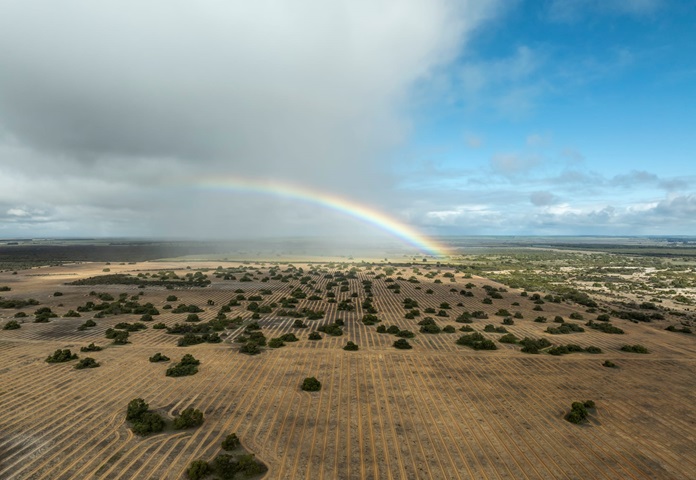
Aerial view of a Woodside property with rainbow on the horizon. Credit: Nick Thake Photo Video
