Indigenous Peoples cultural heritage and engagement 

We acknowledge the unique connection that First Nations communities have to land, waters and the environment.

On this page
2024 RAP Report
Woodside Energy 2024 Reconciliation Action Plan Report

2024 RAP Report

Woodside has released its 2024 Reconciliation Action Plan (RAP) Report. We've seen advancements across our four key pillars: Respect for Culture and Heritage, Capability and Capacity, Economic Participation, and Stronger Communities.

Overview
MATERIAL TOPIC

We acknowledge the unique connection that Indigenous communities have to land, waters and the environment.

We believe Indigenous Peoples1, cultural heritage2 and industry can successfully coexist and that Traditional Owners and Custodians can help us to understand, manage and protect cultural values.

We aim to keep Traditional Owners and Custodians central to heritage management so that cultural values are understood and remain protected. We understand the importance of identifying and working with Indigenous people who have longstanding cultural and spiritual connections to land and waters where our activities occur. Through effective consultation, we are guided by Indigenous Peoples in our efforts to avoid or minimise potential impacts from our operations – we believe this improves cultural heritage management performance, and reduces the risk of unanticipated disruption to business activities. We also seek to partner with Indigenous communities to support positive outcomes that benefit both our business and the communities in which we operate.

We acknowledge there may be diverse perspectives within Indigenous communities in the areas in which we operate. Therefore, Woodside engages through the authorised representative organisations appointed by the Indigenous communities.

When communicating with a wide audience, Woodside uses the term "Indigenous Peoples" to refer to Traditional Owners and Custodians. At a local level, Woodside is guided by the community on the appropriate terminology.

Our approach

Our approach3

Woodside’s Indigenous Communities Policy (Policy) defines and sets out our approach to engaging with Indigenous communities and is subject to regular review and update. Our employees, contractors and joint venture participants engaged in activities under Woodside’s operational control are responsible for applying the Policy, and receive training appropriate to their roles to support the implementation of the Policy. This Policy also states that Woodside is guided by United Nations Declaration on the Rights of Indigenous Peoples (UNDRIP).


As a global company, we engage with a range of community stakeholders around the world

In Australia, we maintain relationships with Indigenous communities in a number of areas of Australia, including the Pilbara, Kimberley, South West of Western Australia (WA) including Perth, and in coastal Victoria. Internationally, we maintain relationships with Indigenous communities in New Zealand and the United States.

Woodside is guided by the United Nations Declaration on the Rights of Indigenous Peoples and we seek to engage with affected communities of Indigenous Peoples in ways that are consistent with the principles of seeking Free, Prior and Informed Consent (FPIC), which establishes an obligation on States to “consult and cooperate in good faith with the Indigenous Peoples concerned through their own representative institutions in order to obtain their free and informed consent prior to the approval of any project affecting their lands or territories and other resources”.4

Although this obligation is expressly assigned to States, Woodside is guided by these principles through:

  • Engaging through representative institutions with cultural authority to represent Indigenous communities.
  • Being guided by Indigenous communities on their preferred methods of consultation, including the format, attendees, cultural protocols, location and timing.
  • Providing relevant information through accessible communications including fact sheets and face-to-face engagements.
  • Supporting representative institutions so that they are resourced to access credible, independent expert advice where required.
  • Listening to the voices, views and aspirations of Indigenous communities and leaders so that they are heard and considered within Woodside, and incorporated into decision-making processes.
  • Adhering to our Anti-Bribery and Corruption Policy, which recognises that Indigenous Elders or representatives authorised to act on behalf of an Indigenous group or community may be considered government officials.

In 2025, Woodside made a submission to the United Nations Working Group on Business and Human Rights in regards to United Nations Call for Inputs - Indigenous Peoples’ Free, Prior and Informed Consent (FPIC), Business and Human Rights. Previously, in 2022, Woodside made a submission to the Joint Standing Committee on Aboriginal and Torres Strait islander Affairs expressing support for clarity in Australian law in relation to FPIC so that communities and companies understand their rights and the aspirations of UNDRIP. Woodside was the only energy or resource company to make a submission to the inquiry.

Our submission can be found at Government submissions & reports

Our performance

Our performance5

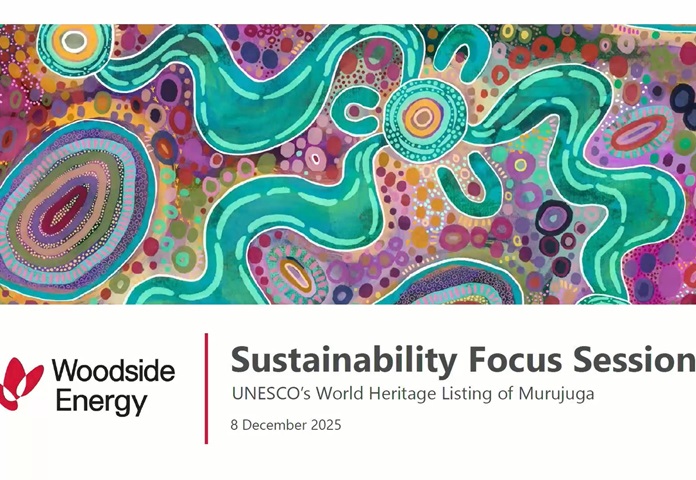
  • In 2025, the Murujuga Cultural Landscape was successfully inscribed on the UNESCO World Heritage6 List. Woodside proudly supported the Indigenous-led World Heritage nomination and assessment process with the Western Australian and Australian Governments. Further information about our support can be found in our related information section below.7
  • Woodside will continue to collaborate with MAC and Traditional Custodians to support coexistence of Woodside’s operations with the World Heritage property’s Outstanding Universal Values8.
  • In Australia, Woodside consulted with more than 45 Indigenous stakeholder groups as well as individuals to support the preparation of Environment Plans, with resources provided where necessary to enable participation.
  • In 2025, two Indigenous Advisory Group roundtable discussions were held. These roundtables are an opportunity for senior Woodside Executives to gain insights through Indigenous perspectives. The roundtables share knowledge, context and concerns with Woodside, identify positive features of our work, recommend areas for improvement, help inform decision-making processes and strengthen relationships with communities.
  • In 2025, Woodside continued to engage with Indigenous Peoples in areas where we are active. These engagements strengthened our relationships and increased our employees' cultural awareness, understanding, and respect. These included:

    1. In British Columbia, we participated in the Fort Nelson First Nation cultural celebration, which marked 115 years since the signing of Treaty No. 8 and honoured the traditions, community spirit and cultural strength of the Dene and Cree peoples.
    2. In Ngumpan, outside of Fitzroy Crossing, we attended the Kimberley Aboriginal Land and Culture Centre (KALACC) Festival’s 40th anniversary, which drew people from across the Kimberley to celebrate culture and community through dance, song and story. A defining moment was the announcement of the Kimberley Aboriginal Regional Body, comprising elected representatives to advocate on key issues affecting the region and its people.
  • In the Kimberley, we strengthened our relationship with the Kimberley Aboriginal Law and Cultural Centre by supporting their capacity to deliver services to their members, and building our own internal awareness and understanding of issues impacting Indigenous Peoples in the Kimberley.
  • In late 2024, Woodside made a contribution to the funding for a rigid-hulled inflatable boat, additional camera equipment and two years of operating costs for use by the Murujuga Aboriginal Corporation in caring for the sea country and islands of the Dampier Archipelago. In 2025, there were celebrations to mark the vessel's delivery and naming.
  • In 2025, grants were awarded to two Indigenous organisations to purchase equipment and undertake training to enable these groups to participate in carbon farming activities such as tree planting and land maintenance. These grants form part of Woodside’s Indigenous Capacity Fund that supports Indigenous enterprises to build foundational capacities and skills to enable participation in the carbon industry.
Our continued commitment to reconciliation

Our continued commitment to reconciliation

Woodside has participated in Reconciliation Australia's Reconciliation Action Plan (RAP) program since 2009, when we became the first energy company to join the program. Overseen by Reconciliation Australia, RAPs require participants to publicly nominate and report on practical actions they are taking to advance reconciliation.

We believe we can partner with Indigenous communities to create positive outcomes that leave a lasting legacy, improving both our business and the communities in which we operate. Indigenous Peoples make up a significant proportion of the population in the areas where we operate, with the potential to contribute to our business as employees, contractors and suppliers. Woodside has participated in Reconciliation Australia's RAP program since 2009, when we became the first energy company to join the program. RAPs require participants to publicly nominate and report on practical actions they are taking to advance reconciliation.

We are recognised as a leader in reconciliation with our fourth plan, the 2021–2025 RAP, and in 2025 achieved the fourth reporting milestone by releasing the 2024 RAP Report.

We monitor long-term impact outcomes and report annually on progress against commitments aligned with the four pillars of Woodside’s current RAP:

  • Respect for culture and heritage
  • Capability and capacity
  • Economic participation
  • Stronger communities.

Australian Indigenous employment is a key focus for Woodside and its workforce and is identified as an indicator under Pillar 3 “Economic participation” of Woodside’s RAP in Australia with a target of 6.6% Indigenous workforce in 2025.

Workforce Cultural Competency is also recognised as an important measure and an indicator under Pillar 1 “Respect for culture and heritage” of Woodside’s RAP in Australia. Employees are encouraged to complete cultural learning annually, with a target of 90% completion in 2025.

In 2026, Woodside will implement its Indigenous Peoples Strategy, which is Woodside’s global equivalent of a RAP. The Strategy’s intent is to build meaningful partnerships with Indigenous Peoples everywhere we operate. By working together, we safeguard cultural heritage, strengthen communities, and create economic opportunities guided by self‑determination.

Related information

Related information

Click on each of the following topics to view more about it.

Footnotes

    Footnotes