2c543a5ebd934c4a97264778ff79cb9f.tmb-multi-cta.jpg?sfvrsn=d6c7768b_2)
.tmb-multi-cta.png?sfvrsn=860f7c4c_2)

-
98 %
of community partners advised they were able to reach more participants or spend more time with existing participants.

.tmb-page-title.jpg?sfvrsn=c8c5474b_3)
We strive to build and maintain respectful relationships that celebrate the culture and values of our host communities and generate positive social and economic outcomes.
Conducting our business sustainably is fundamental to the wellbeing of our employees, communities and environment. We aim to create value through inclusive engagement, local economic participation and long-term capacity building.
Managing activities in a sustainable way is fundamental to the wellbeing of our workforce, communities and environment. We aim to create value through inclusive engagement, local economic participation and long-term capacity building by investing in the communities we call home and the people who live there.
Our Values guide everything we do and underpin our continued focus on safety and environmental and social performance. At Woodside, we regard strong sustainability performance as a key driver of our success and ability to generate enduring shareholder returns.
The way we work is guided by our Policies, Procedures, Social Performance Framework and Our Values. These documents set the expectations for how we foster respectful relationships, manage adverse impacts and create opportunities.
Woodside seeks to identify, understand, manage and monitor potential impacts and opportunities associated with our activities.
Our Social Performance Framework guides our approach as we seek to build trust, share timely information about our activities and understand the expectations of the communities where we are active.
Social performance plans are updated annually in each community where we are active, including in the north west of Western Australia (Karratha, Roebourne, Exmouth, Onslow, Broome), the United States (Louisiana, Beaumont, Gulf Coast), Mexico, Senegal and Timor-Leste. The plans support projects and operating assets to identify their social performance priorities and highlight social licence to operate risks and emerging trends. Woodside leaders endorse their relevant plan to ensure they are fit for purpose and reflect the nature, scale and impact of our activities.
Woodside tracks its performance against these plans using a social performance dashboard updated quarterly and shared with leaders within Woodside. It includes the review of social performance, and considers emerging trends, community indicators and stakeholder sentiment. It is used to assist the business in understanding community needs and aspirations and growing knowledge of social performance priorities within our teams and employees.
As stakeholder expectations continue to evolve, ensuring the business is informed of the key social risks and opportunities is a key enabler to effective management and protection of our social licence to operate. Integrating and embedding social performance into strategy, processes and culture will be a continued focus throughout 2026.
Woodside’s performance is assessed by a number of external selected sustainability ratings indices and benchmarking organisations that specialise in sustainability performance across a broad range of companies, including in the oil and gas sector. The outcomes of the most recent assessments from S&P Global, Sustainalytics and MSCI can be found on Sustainability - Woodside Energy.

Woodside’s community grievance framework is designed to facilitate prompt and respectful receipt, investigation and response to community concerns from stakeholders in our operational areas.
In 2025, our new grievance process was in operation. Our grievance mechanism continues to strengthen our alignment to the grievance effectiveness criteria outlined in the United Nations Guiding Principles. Updates to local community mechanisms and training to employees who manage community concerns were also completed in 2025.
We received four community grievances in 2025 from our operational areas. All grievances were addressed and discussed with relevant community members. They related to flaring, housing and decommissioning. The number of grievances in 2025 decreased by six from 2024.
More information on Woodside’s grievance process can be found on our Community Concerns page.
People and places
Every five years, we refresh our social investment strategy to ensure our investments remain aligned with the needs and priorities of our host communities, seek to deliver measurable social and economic outcomes and demonstrate respect for local cultures, values and ways of life.
The evolution of our approach is especially important as Woodside continues to grow our operations in Australia and globally.
Each community is different and we know a one-size-fits-all approach doesn’t work, so our 2026 – 2030 global social investment strategy is grounded in a commitment to the places we call home and the people who live there.
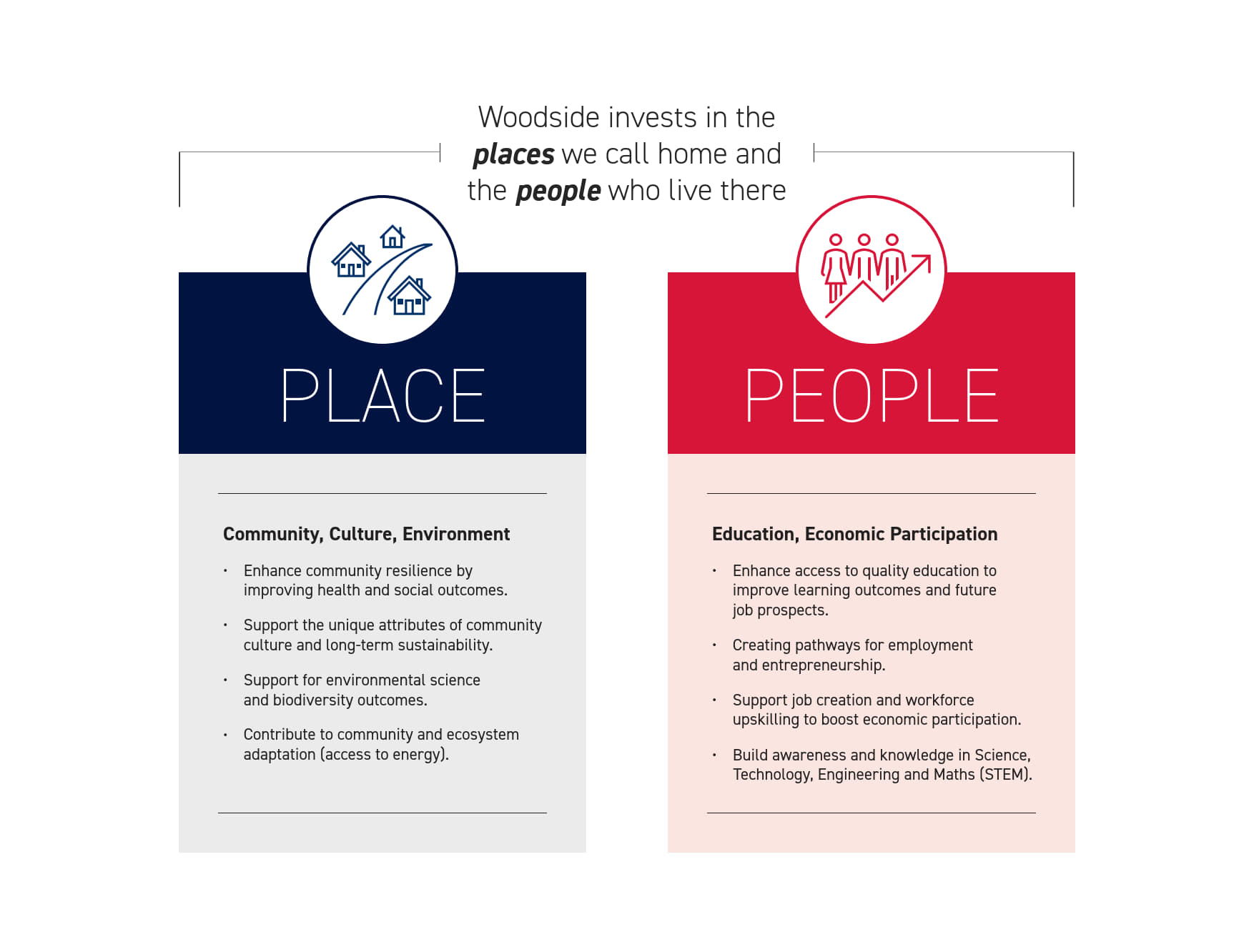
Our strategy recognises that strong communities depend on people having access to opportunity; with health, education and economic participation key contributors to a person’s wellbeing.
To this end, our social investment strategy supports access to quality education at all stages of life, particularly around Science, Technology, Engineering and Maths (STEM), to improve learning outcomes, enhance employment prospects and create long-term opportunities.
By supporting pathways for employment and entrepreneurship, job creation, and workforce upskilling, we aim to enable individuals to thrive and contribute to the strength, wellbeing and resilience of their communities.
For Woodside, a place we call home is shaped by community, local cultures and the surrounding environment. While this looks different across the world, our approach is consistent: working closely with local partners to deliver outcomes that are locally relevant, sustainable and enduring.
Our ambition, together with our community partners, is to strengthen community resilience through improved health and wellbeing, social outcomes and access to reliable energy; alongside targeted support for scientific research and biodiversity outcomes.
Finally, our social contribution does not stand alone. It complements Woodside’s broader economic contribution through employment, local procurement, taxation and royalties, and supports stable, resilient communities and operating environments over the long term.
Woodside seeks opportunities to partner with not-for-profit organisations by providing funding through community grants. Grants of up to A$5,000 are available to support eligible community initiatives. This is part of our commitment to building local capacity and developing opportunities for community wellbeing. If you’re a club or organisation with a great idea or in need of some extra support we want to hear from you.

Applications for round 2 of our 2026 Community Grants Program in City of Karratha, Exmouth and Onslow regions are now open.
Woodside’s 2021–2025 Social Investment Strategy has delivered meaningful and measurable outcomes for the global communities where we are active. Guided by three social outcome areas - improve knowledge, create opportunities, and build resilience - we have collaborated with local organisations and invested in long-term initiatives focused on outcomes that matter most to our host communities.
Across 2021–2025, data from our annual social impact measurement survey of community partner organisations shows our social investment programs have delivered sustained and measurable benefits and indicate our social investment strategy has been effective in generating both social value and organisational resilience.
The information in the bar chart summarises the outcomes delivered over the life of our 2021–2025 Social Investment Strategy.
98 %
96 %
92 %
88 %
82 %
Responses are aggregated from community partners who completed Woodside’s annual social impact surveys across the 2021–2025 period.
A$39.8 million
A$25.3 million
A$2.3 million
A$5.0 million
A$7.2 million
.tmb-v2-card.jpeg?sfvrsn=63cd1e14_1)
Ningaloo Outlook – Turtle Education Program, CSIRO. Credit: Violeta J. Brosig from Blue Media Exmouth.
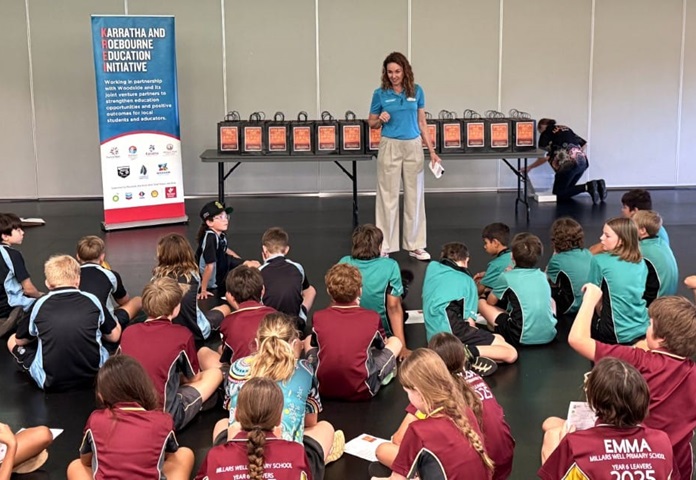
Since 2007 Woodside and its joint venture participants have committed to boosting education resources in the Pilbara and improving student outcomes with programs such as the Karratha and Roebourne Education Initiative (KREI).
In 2025 more than 200 primary school students, of whom 15 were Aboriginal and Torres Strait Islander students, participated in the Student Leadership Alliance (SLA), an offshoot program of the KREI designed to develop leadership and communication skills.
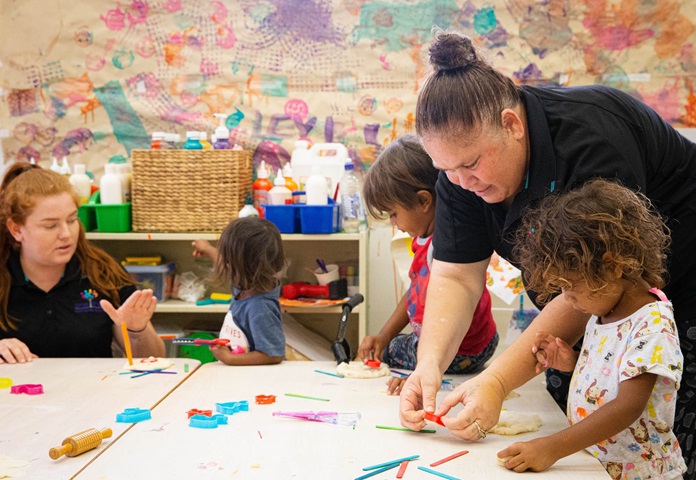
Communities are navigating complex challenges which do not come with single or simple solutions. In 2014 Woodside posed a challenge to our own teams of how can we best support the growth of strong, healthy and sustainable communities.
The answer was the Woodside Development Fund (WDF). The fund was a 10-year commitment to improving early childhood development (ECD) outcomes in communities where Woodside operated.4
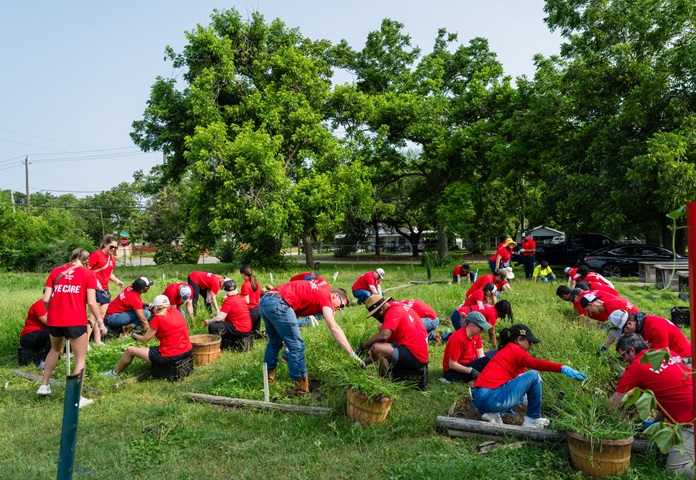
In 2005 Woodside was one of the first companies in Australia to introduce corporate volunteering. Over the past two decades, our employees have contributed more than 150,000 hours to support community groups and not-for-profit organisations.
Their enthusiasm has helped embed volunteering into our company’s culture and our volunteering partners often applaud our staff for their passion, dedication, and unwavering commitment to giving back. This appetite for giving back shows no sign of diminishing.
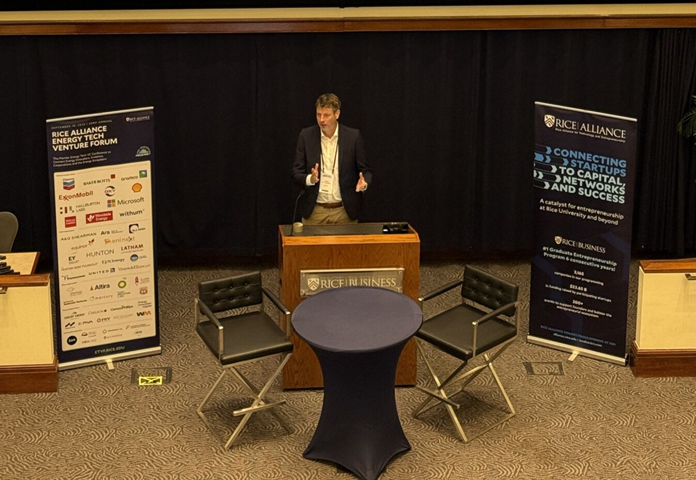
At Woodside, innovation is at the heart of everything we do. In 2025 we invested more than A$35 million in our collaborations with universities, technology partners, and commercial ventures to advance new ideas and technologies.
By combining our core capabilities with global engagements, we can tackle complex challenges and drive continuous improvement in business innovation.
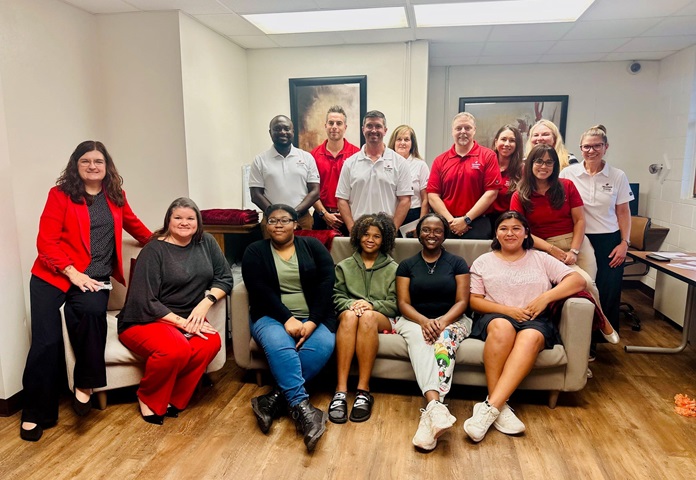
Woodside is a proud supporter of Nicholls State University (Nicholls) located in Thibodaux, Louisiana, and its retention efforts for first-generation and high-risk student populations through the Woodside Living Learning Community (LLC) in collaboration with the Nicholls Foundation.
Woodside LLC is an academic program that seeks to unite students through celebrating common and individual experiences, ultimately guiding participants to flourish and succeed in all facets of life. It strives to empower young men and women to see their intrinsic worth and foster a legacy of mentorship, leadership, equality, academic success and professionalism.

Photo by Polly Glover – Least Tern Chick at Fourchon Terraces - © 2025. Restore or Retreat, Inc.
The marine environment of the southern coast of Louisiana in the United States —including its coastal wetlands, marshes, and barrier islands—plays a vital role in supporting diverse plant and animal species while helping protect local communities from storms, flooding, and land loss.
These valuable habitats continue, however, to face increasing pressure from coastal erosion.
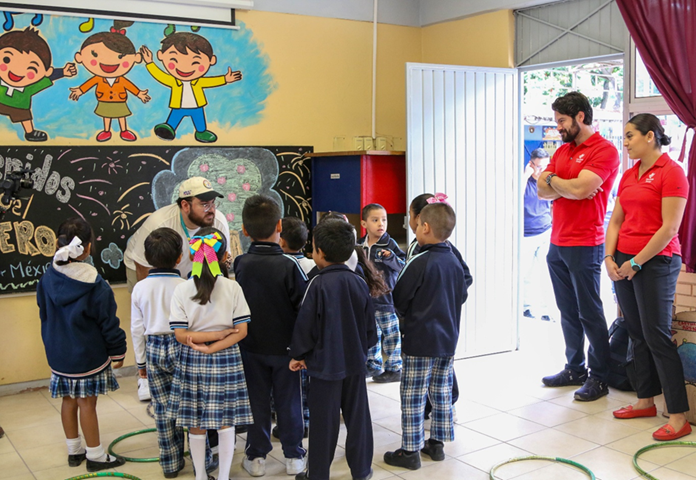
Schools that Learn is an educational improvement program delivered by Enseña por México in collaboration with Proyecto Nuevo Maestro (PNM), with support from Woodside.
The program aims to develop students’ social-emotional skills and improve their academic performance, while strengthening leadership among teachers and school principals and fostering a positive school environment. As a result, 71% of students demonstrated sustained growth in their social-emotional skills, reaching the highest levels of emotional wellbeing, and 81% of students improved their academic performance by 12 or more percentage points compared to initial assessments.
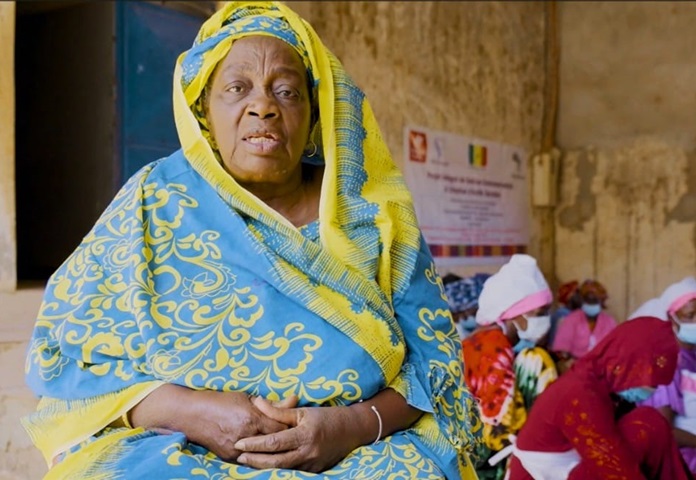
Adja Fatou Dramé, President of Linguères de l’Émergence
In Senegal, Woodside has partnered with PETROSEN, the National oil company, in supporting PanAfricare to assist women diversify their sources of income.
In Toubab Dialao, a picturesque fishing village about 50 kilometres south of Senegal’s capital, Dakar, some of its women belong to a local business group called Linguères de l’Émergence ‘Women Leaders in Economic Empowerment‘. For a long time, their lives were organised around the rhythm of the tides, as fishing was more than just a means of subsistence, it was the heart of community life.
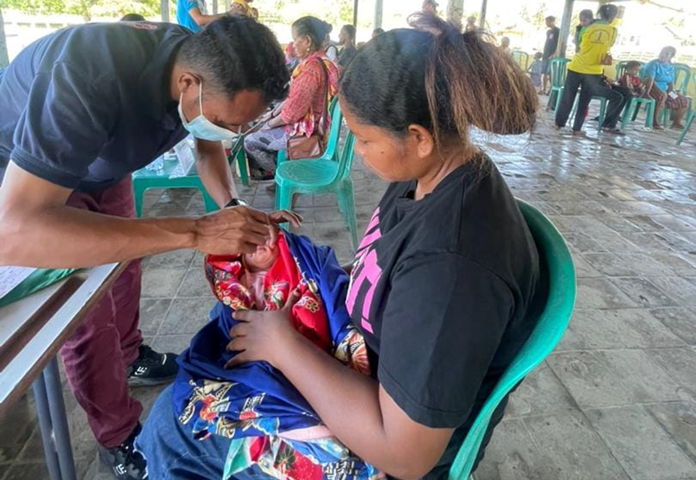
Remote communities in Timor-Leste, particularly in Manufahi Municipality in central Timor, face significant barriers to healthcare due to rugged terrain, poor infrastructure, and a shortage of health professionals.
Recognising these challenges, Woodside and the Sunrise Joint Venture (SJV) participants launched the Health Outreach Program (the program), a health outreach initiative aligned with the Ministry of Health’s Programa Integradu Saúde (PIS), which aims to deliver essential medical services directly to underserved villages.
Woodside continued to strengthen our commitment to local procurement by embedding inclusive practices and supporting economic participation across the communities in which we operate. We engaged consistently with local suppliers, Indigenous and community-based enterprises to foster growth, and deliver long-term benefits through collaboration.
In 2025 Woodside spent more than US$9.3 billion in goods and services, with the majority of this directed to Australia, the United States, the Republic of Korea, Senegal and Mexico.
Woodside enhanced visibility and access for local and diverse suppliers across projects and operations through engagement workshops, development programs, local buying initiatives, knowledge forums and networking events with key contractors. Forward work plans were published to help suppliers anticipate upcoming opportunities, and procurement reporting tools were developed to measure community impact and align our approach with the Sustainable Communities Policy, Human Rights Policy, Indigenous Communities Policy and our commitment to Indigenous Peoples reconciliation.
As we look ahead, Woodside will continue to strengthen supplier capability, deepen partnerships, and drive inclusive, sustainable economic activity across all regions in which we operate.
1. The graph displays the top five countries by spend; totals shown do not equal 100% of overall spend.
Click on each of the following topics to view more about it.
.tmb-square_l.jpg?sfvrsn=745b0864_1)
Applications for round one of our Community Grants Program in Karratha, Exmouth and Onslow open Sunday, 1 March 2026. Grants of up to A$5,000 are available to support community initiatives in the City of Karratha, Shire of Exmouth and Town of Onslow. It’s part of our commitment to building local capacity and developing opportunities for community wellbeing. If you’re a club or organisation with a great idea or in need of some extra support we want to hear from you.
Applications for round one of our Community Grants Program in Karratha, Exmouth and Onslow are now open.


.tmb-r-story.jpg?sfvrsn=7e0d6e1a_1)