
Out-of-the-box thinking at Woodside’s Hydrogen Refueller
The sky is the limit at Hydrogen Refueller @H2Perth.
Some out-of-the-box thinking has delivered a number of improvements at the construction site in the Rockingham Industry Zone, south of Perth.
Hydrogen Refueller @H2Perth (Hydrogen Refueller) is Woodside’s self-contained hydrogen production, storage and refuelling station that aims to supply heavy vehicles, passenger cars and tube trailers. First hydrogen production is expected in the first half of 2026. Through a collaboration between the Hydrogen Refueller Project team and Technology, the use of drones has delivered some surprising rewards.
“Embracing new technology early has unlocked far more use cases than we originally imagined and has shown how innovation can truly shift the trajectory of a project,” reports Soon, Deputy Project Manager Hydrogen Refueller @H2Perth.
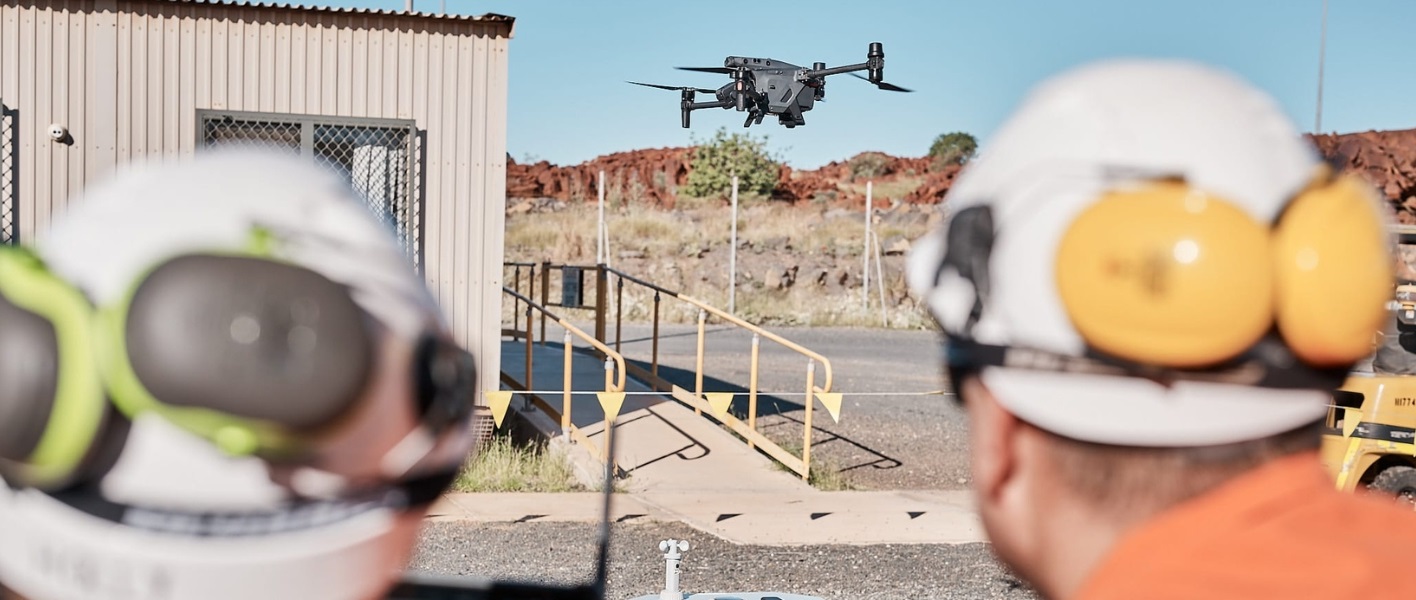
Drone technology was first deployed at the site to collect footage during internal stakeholder engagements. Drones had the advantage of minimising disruption to construction activities. This usage evolved into environmental monitoring, namely surveying hollow trees at the site. New uses kept surfacing, as Soon explains.
"It's been exciting to see drone technology evolve from a stakeholder engagement tool to something we now rely on daily – for project progress monitoring, storytelling with stakeholders, supporting engineering and construction, such as surveying of hollows, and even night-time security," Soon recounts.
Moreover, not only do the drones keep an eye on the site, because they are equipped with speakers, they can issue warnings to potential trespassers. And if a bush fire were to occur, they could potentially be utilised by firefighters. The drone footage was initially combined with innovative technology involving a mixed-reality headset integrating digital media with the real world, and the Project team soon realised drones would be great for tracking the project’s progress.
“So weekly aerial capture of the site was initiated and that started to unlock the true benefit of this dataset,” Soon adds.
The Technology team used drone technology to capture time-lapse aerial footage and images, providing an opportunity to share construction activities in near real-time. The imagery collected by the drone was processed into 2D and 3D maps. These helped in areas such as flood analysis, landfill removal calculations for trucking optimisation and for crane lifting plans. Additionally, using drones on site can reduce health and safety risks as well as the number of personnel needed on the ground.
Originally, a drone and operator were transported to the project site to obtain the aerial footage. However, with the escalating pace of site changes, there was a demand for daily site captures which involved significant logistical planning. As it became clear that drone technology could be utilised in a wide range of applications, a different way of using these “eyes in the sky” surfaced. So Beyond Visual Line of Sight (or BVLOS) technology through Drone-in-a-Box (DiaB) was recommended, which would enable remote drone operations.
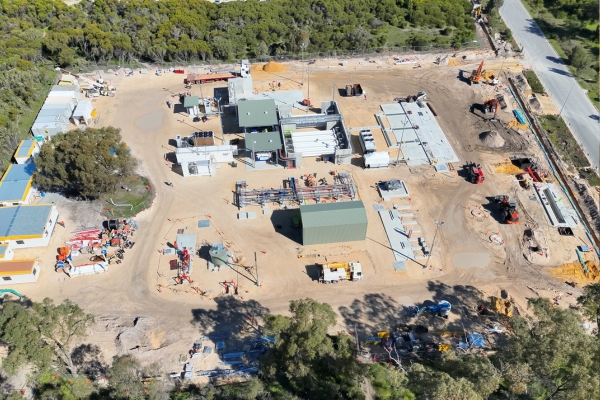 | 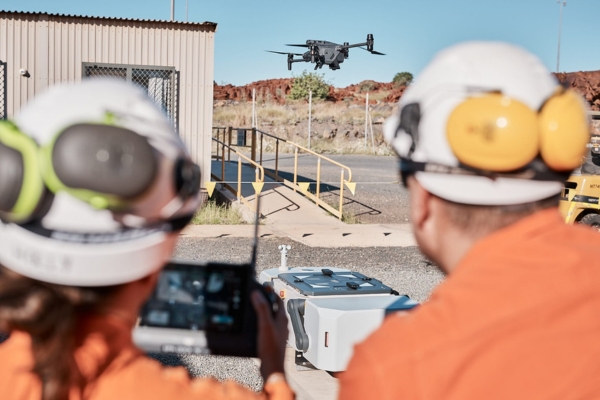 |
Today, aerial capture is delivered without site visits, generating possible cost savings and minimising impact on site. A single drone is remotely operated by a pilot based in Subiaco, about 40 km away from the site. The drone flies twice daily, up to five days a week while further reducing site disruptions and is on call for ad hoc flights 24/7 to provide site surveillance and security.
“Drone technology has greatly improved the team’s ability to coordinate the works on site, reducing the impact of work groups on each other’s activities and maximising productivity,” explains Jamie, Construction Lead Hydrogen Refueller @H2Perth. “The technology also gave us the ability to superimpose cranes over the pictures ensuring we could get the smallest crane possible, maximise the usage and reduce costs.”
More broadly Technology and Aviation have been working together to develop the capability to safely and reliably use drones at scale across the organisation, under the auspices of the newly created Drones@Woodside team.
Harley, Drones Platform Lead, says other uses of drone technology are currently under review at Woodside.
“This has been a great project to demonstrate quick and effective solutions for the project team and having close collaboration where we can iterate on a solution that continues to create further value has been so rewarding,” Harley notes.
Moral of the story?
“Lean into out-of-the-box thinking,” Harley suggests. “Because that’s where your ideas can really take flight.”